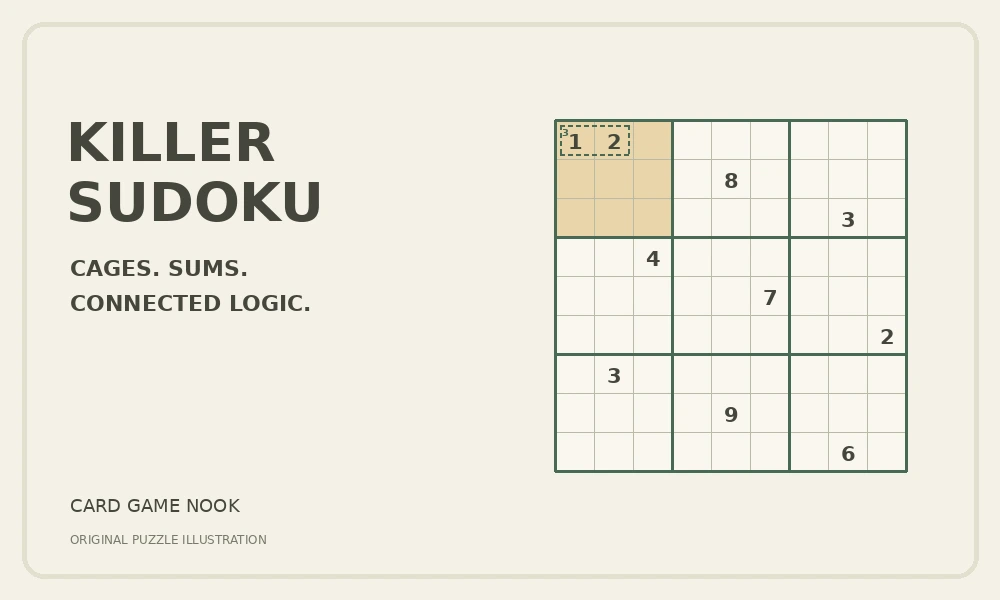
Killer Sudoku: Follow the Cages, Find the Missing Digits
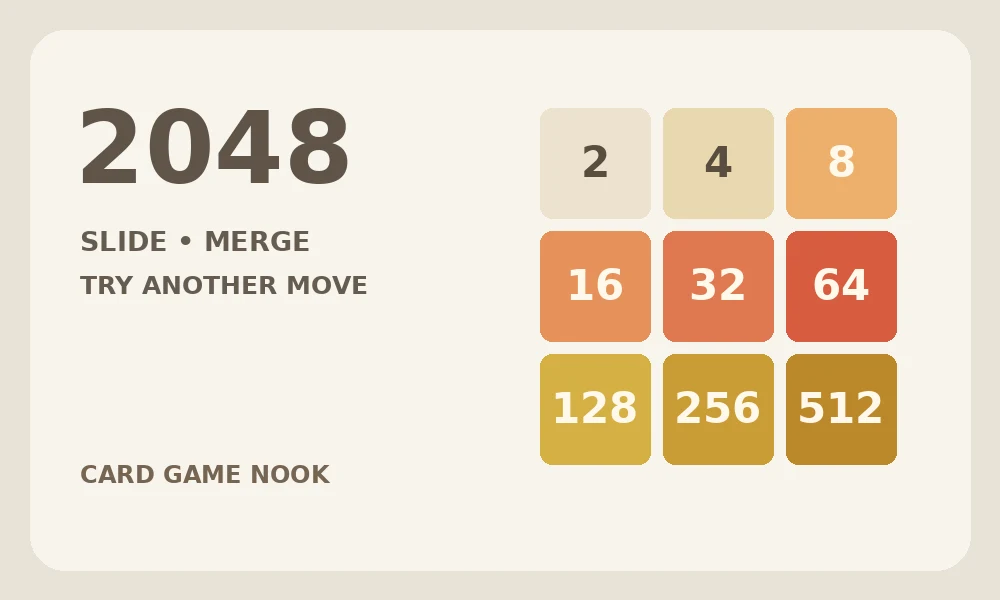
A dashed outline turns an ordinary sudoku square into part of a second puzzle. In Card Game Nook’s Killer Sudoku, each row, column and 3 × 3 box must contain 1–9 exactly once, while every cage must reach its printed total without repeating a digit. The same cell belongs to both systems. This is a related number-logic challenge, not a 2048 variant: you place missing digits rather than slide or merge tiles.
Select an empty cell and choose a digit using the on-screen controls or keys 1–9. Arrow keys move the selection; Backspace clears an entry. Start with the printed clues and a small cage whose total limits its options. Two cells adding to 3 must hold 1 and 2, while a total of 17 needs 8 and 9. Those pairs do not tell you their order: the crossing row, column and box decide which digit belongs where. No digit may repeat within a cage, even when its cells cross a box boundary.
Every complete row, column and box totals 45. If cages lying entirely inside a box cover eight cells and total 38, the remaining cell must be 7. Check the outlines carefully before subtracting: a cage that extends outside the box cannot be counted as wholly inside it. Pencil marks help you compare possible digits. Undo restores the previous entry, and Hint explains a deduction when one is available; on harder positions it may instead disclose that it is using the solution. A falling Empty count shows progress in filling cells, not proof that every answer is correct.
New puzzle opens a fresh grid at the chosen level. The menu includes difficulty and pencil-mark options; the hardest level starts without printed digits, so cage totals provide the clues. Aim for all 81 cells filled with every sudoku and cage constraint satisfied. Take a moment after each placement to revisit its cage: one settled digit can narrow several remaining choices. The embedded board is supplied by Card Game Nook, whose credit link remains visible beside the game.