2048 Fibonacci: Find Your Number’s Next Neighbor
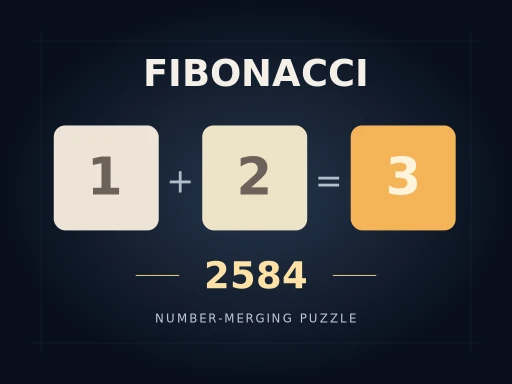
2048 Fibonacci changes the question you ask before every move. Instead of looking for two identical numbers, look for neighbors in the Fibonacci sequence: 1, 2, 3, 5, 8, 13 and onward. There is one starting exception, 1 + 1 = 2. After that, 1 + 2 makes 3, 2 + 3 makes 5, and 3 + 5 makes 8. Two 2s do not combine, and neither do 3 and 8. The goal on this 4×4 board is to build a 2584 tile.
Click inside the game area to give it keyboard focus, then use the arrow keys. Every directional move slides all tiles that can move that way, not just the pair you have noticed. When compatible values meet, their sum becomes the next tile in the sequence. New small tiles appear as play progresses, so the board you planned around changes again. Read the whole position after each move. The black background, gray board and light numbered tiles keep the presentation simple, but a familiar appearance does not mean familiar merging rules.
Try arranging values into an increasing chain, with each number close to a neighbor it could eventually join. Leave routes for incoming 1s and 2s rather than treating them as disposable obstacles. Before making a tempting merge, ask where its result will land and which value it needs next. An empty square can be more useful than an immediate small combination if it preserves room to rearrange. A corner can help organize the largest values, but copying classic 2048 moves without checking the sequence can leave incompatible numbers trapped together. These are planning ideas, not a guaranteed winning method.
If the board fills and no legal move remains, the game displays “Game over!”. Select “Try again” to start a fresh board with the score reset to zero. The “Best” field shows the best-score figure; keep your attention on the current board and the next useful pairing. This version is provided by 2048 Alphabet at https://2048alphabet.com/fibonacci/ and credits Joshua Liebow-Feeser’s Fibonacci adaptation, with Misho M. Petkovic / Orange Unit identified on the source site. The embedded interface is in English, and the source site may show advertisements.